You know how it is. The phone rings, you answer it, and some bloke on the other end tells you there’s been a bit of an… “incident”. No names, no questions, and definitely no police. Apparently, somebody has made one hell of a mess and, unfortunately for me, I’m the poor sod being paid to make sure that mess disappears before anyone starts asking awkward questions. Blood on the walls? Gone. Bullet casings scattered across the floor? Never saw them. Dead body in the corner? What dead body?
Welcome to Crime Scene Cleaner, where instead of solving crimes, you’re essentially helping make sure there isn’t enough evidence left for anyone else to solve them either. Developed by President Studio, Crime Scene Cleaner takes the familiar satisfaction of games such as House Flipper and gives it a significantly darker twist. Rather than renovating someone’s kitchen because they’ve made questionable decorating decisions, you’re scrubbing blood out of the carpet because somebody made some considerably worse life choices. Somehow, despite the corpses, blood, criminal activity and the constant reminder that I probably know enough to mysteriously disappear myself, it is strangely relaxing. I suppose crime really does pay… until someone decides the cleaner knows too much.
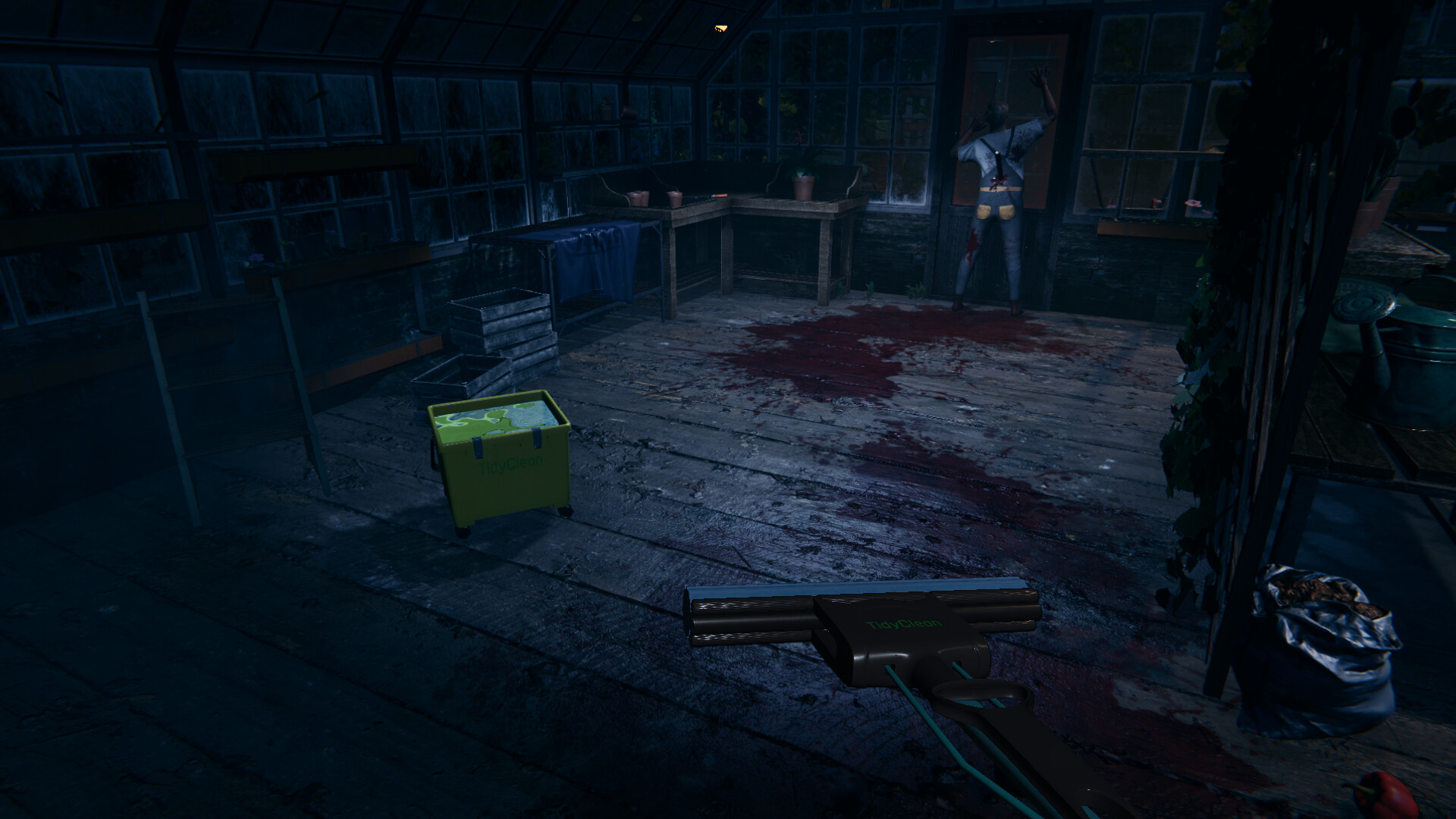
a family man in a very dirty business
At the centre of Crime Scene Cleaner is Mr Kovalsky, a father in a desperate situation. His daughter is seriously ill, the medical bills are piling up, and legitimate work simply isn’t bringing in enough money. When you’re backed into a corner like that, questionable employment opportunities suddenly startspilt, looking considerably more attractive. Unfortunately, Kovalsky doesn’t exactly pick up a few extra evening shifts at Tesco. Instead, he ends up working for the mob, cleaning up after people who clearly don’t believe conflict resolution involves sitting down and having a nice conversation.
Your new employer has problems that need dealing with, and by problems I mean blood, evidence, destroyed furniture and the occasional human being who has recently stopped requiring oxygen. Kovalsky isn’t presented as some hardened criminal mastermind either. He’s a father doing increasingly terrible things because he believes they’re necessary to save his daughter, and that gives the story far more weight than I initially expected. The deeper you get into his situation, the easier it becomes to understand why he keeps answering the phone, even when every sensible part of him is probably screaming that this is going to end badly.
That moral conflict gives Crime Scene Cleaner a surprisingly strong emotional backbone. You know what you’re doing is illegal, Kovalsky knows what he’s doing is illegal, and the bloke zipped inside the body bag definitely isn’t going to complain about it. But when your daughter’s life is hanging in the balance, morality suddenly becomes a luxury you can’t necessarily afford. It creates this constant feeling that Kovalsky has stepped into a world he doesn’t completely belong in, but getting back out might be considerably more difficult than getting in. Because once the mob has your number, changing your SIM probably isn’t going to cut it.
One thing I really enjoyed is that you’re not simply arriving at random rooms covered in red and being told to get scrubbing. The environments help tell you what happened, and some locations can initially appear completely ordinary before you’re shown how events unfolded and everything went catastrophically wrong. One minute you’re looking at something like a perfectly normal pizzeria, and the next there are bullet holes everywhere, furniture has been destroyed, and enough blood has been spilt to make the health inspector immediately hand in their notice.
Seeing the locations and understanding what happened before you begin clearing everything away gives each mission more personality. It also means every scene feels like you’re piecing together a story while simultaneously destroying every piece of evidence connected to it, which admittedly would make me absolutely useless on CSI. “We’ve found a fingerprint.” No, you haven’t. Mop. What I like is that the game manages to tell these smaller stories without needing massive cutscenes constantly interrupting the flow of the cleaning itself.
The variety of locations also helps enormously. Rather than repeatedly cleaning the same type of building, you’re constantly being moved somewhere new, with each area introducing different layouts, hidden rooms, environmental storytelling and secrets to discover. Some places require you to hunt down keys or figure out how to reach certain sections before you can finish the job, giving exploration a genuine purpose outside of simply searching for another tiny bloodstain underneath a chair. And believe me, there is always another bloodstain underneath a chair.
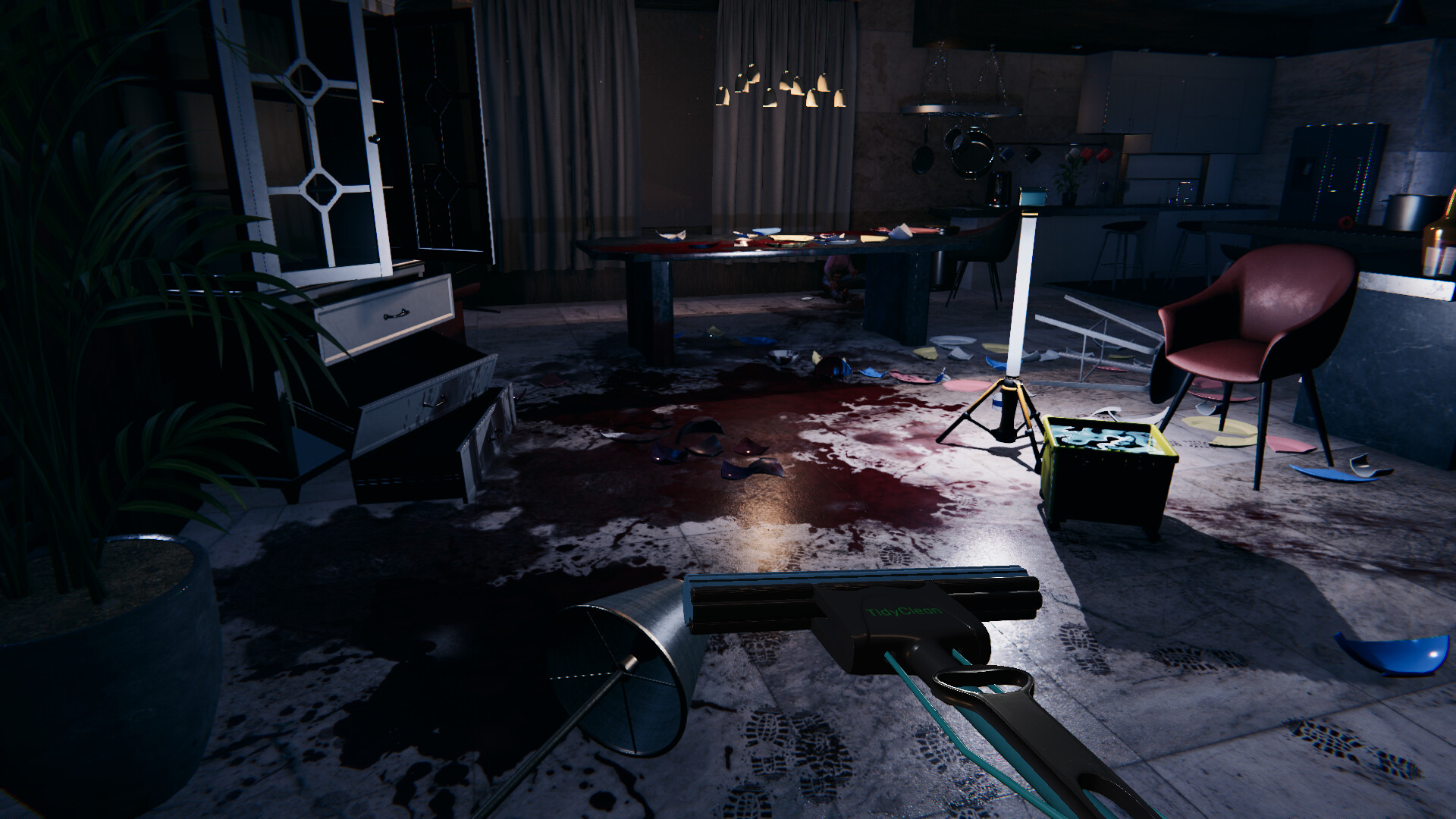
clearing up the evidence
The basic concept behind the gameplay couldn’t be simpler: leave absolutely nothing behind. Bodies need removing, blood needs cleaning, rubbish needs bagging, evidence needs disposing of, and furniture needs putting back where it belongs. Ideally, when you’re finished, the place needs to look like twelve people weren’t recently introduced to the business end of a firearm. Simple enough on paper, but the larger the scenes become, the more you realise just how much work goes into making a crime disappear.
Your trusty mop is naturally one of the most important tools available, but Crime Scene Cleaner gives you several different pieces of equipment as you progress. You can use cleaning products to deal with tougher stains and even grab a Scrub Daddy to get stuck into smaller areas. Yes, a Scrub Daddy. Nothing screams organised crime quite like crouching beside a corpse with a cheerful little sponge while trying to remove blood from the skirting board.
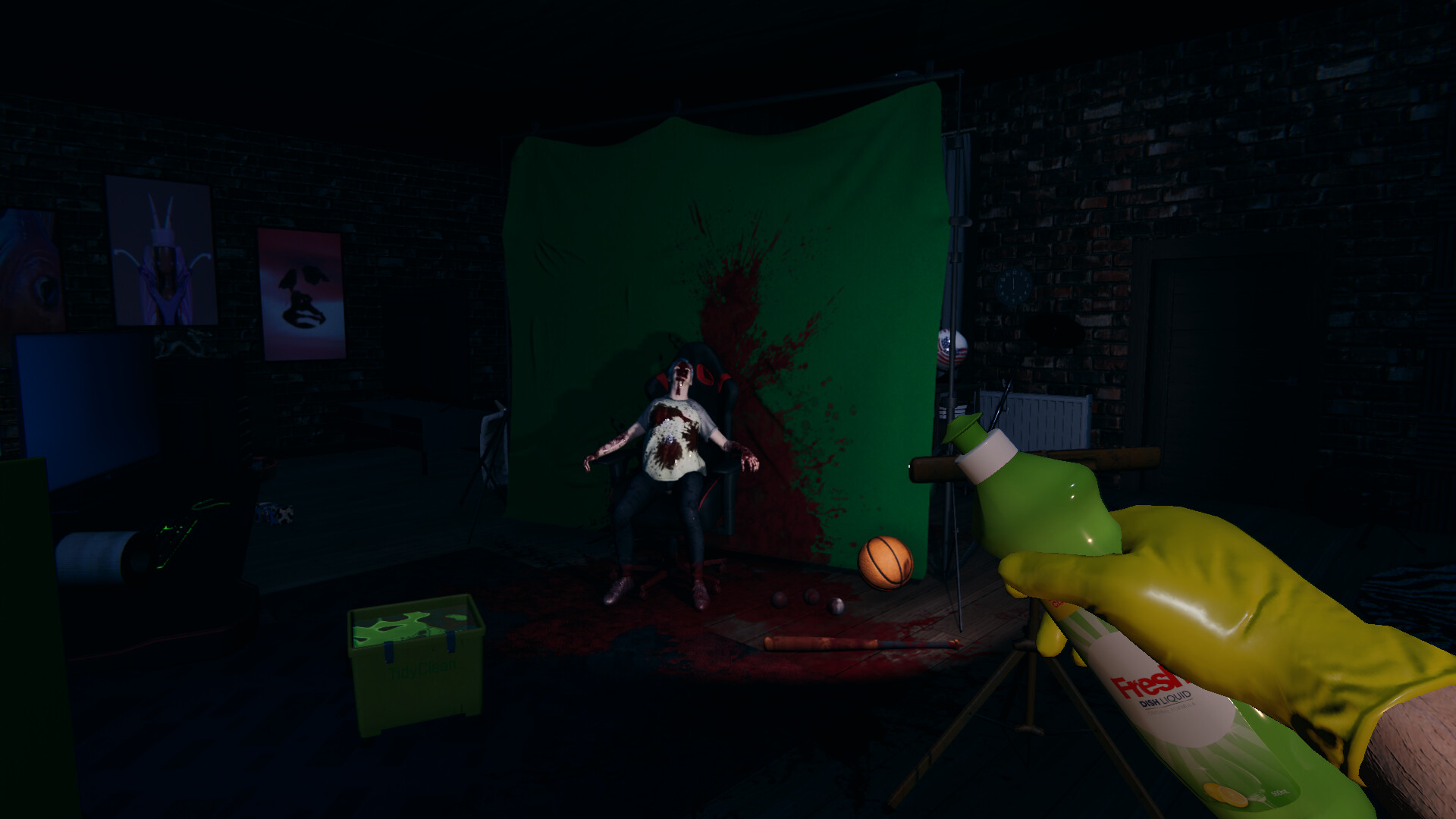
The important thing to remember is that your equipment gets dirty. If your mop or sponge becomes saturated with blood and you continue using it, you’ll simply start spreading the mess around. Congratulations, you’ve somehow managed to make the murder scene worse. Fortunately, buckets can be filled with clean water, allowing you to rinse everything off before getting back to work. It creates this satisfying rhythm of cleaning, checking, rinsing and moving through each room until the entire location slowly begins looking normal again. Well, normal apart from all the people you’ve stuffed into body bags.
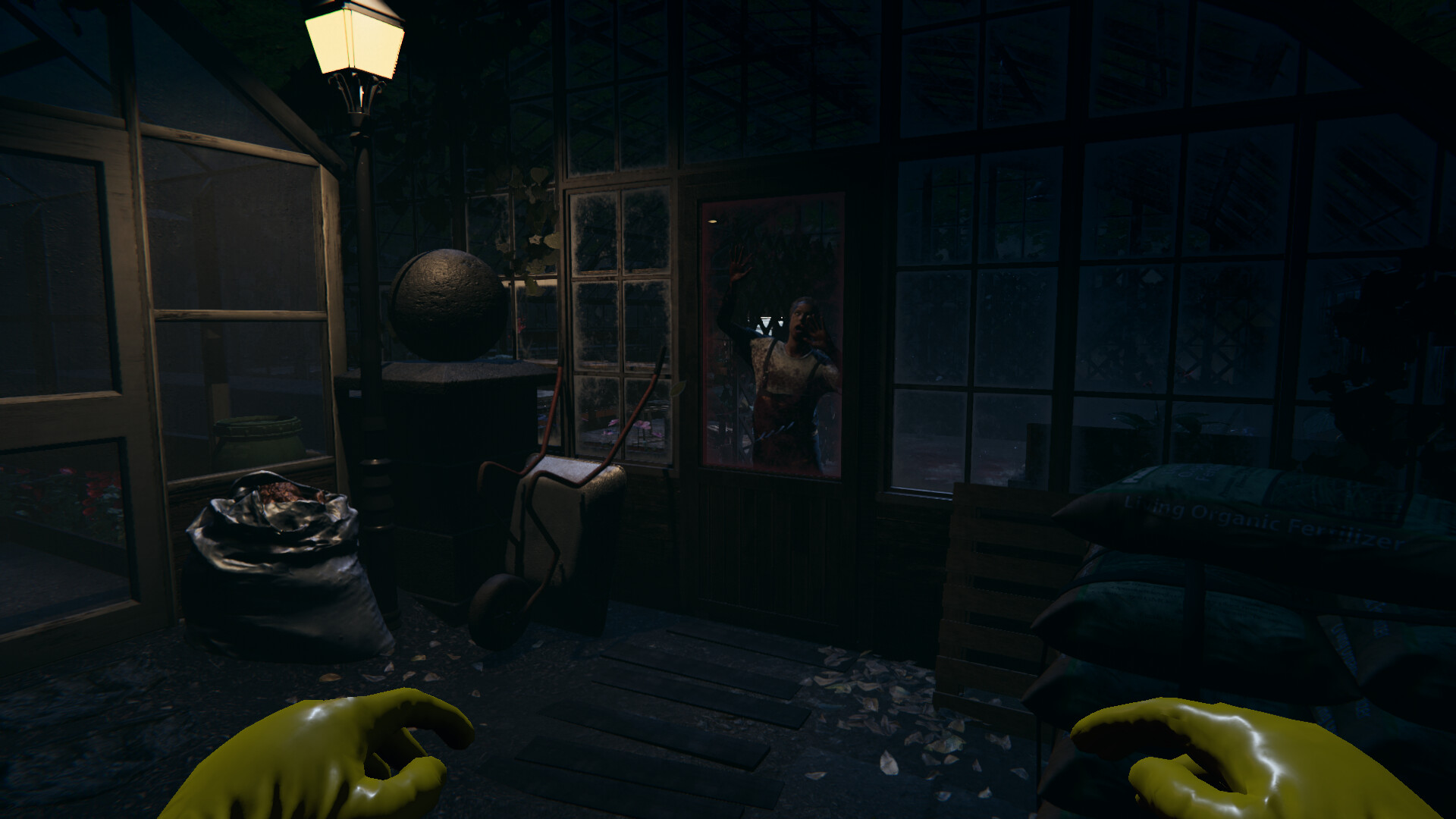
There will inevitably come a point where you stand proudly in the middle of a room thinking, “Lovely. Absolutely spotless.” Then you check your completion percentage, and it says 90%. Excuse me? Apparently, somebody managed to bleed behind a radiator, underneath a cupboard, halfway up the wall and possibly into another dimension. This is where Cleaner Sense becomes one of the most useful tools in the entire game.
Activating Cleaner Sense highlights areas you’ve overlooked, making it significantly easier to locate those final stubborn patches. It might sound like a small addition, but it saves an enormous amount of frustration. Without it, I could easily imagine spending twenty minutes crawling around on the floor desperately searching for three pixels of blood while questioning every decision that led me to this point in life. There’s also a UV light that can be positioned around areas to help expose anything you’ve missed, giving you another way to make sure the job has been done properly.
Between these systems, you’re given enough assistance to remain thorough without the game doing everything for you. That balance works really well because you’re still expected to search the environment and pay attention, but you’re not punished by having to inspect every microscopic corner manually. And when the boss expects perfection, telling him you achieved 98% because there was some blood behind the sofa probably isn’t going to end particularly well.
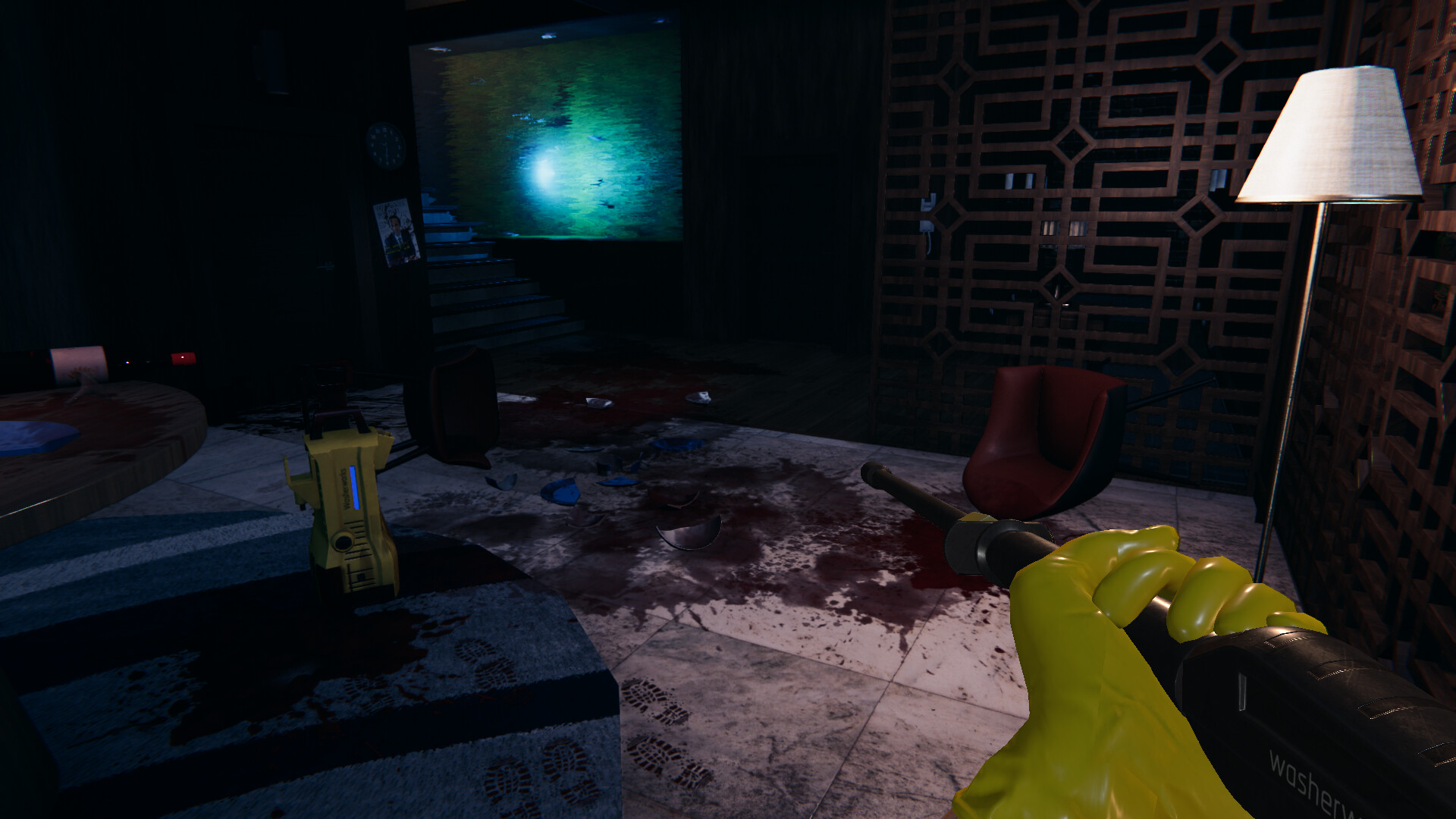
bodies, Bullets and Bin Bags
Once the blood has been dealt with, there’s still plenty of work left. Evidence such as bullet casings needs collecting, damaged items have to be cleared away, and rubbish can be stuffed into bags before being transported back to the disposal area near your vehicle. Each little task adds to the overall clean-up, and what starts as complete chaos slowly becomes a surprisingly organised process as you move from room to room, ticking everything off.
Then we get to the main attraction: the bodies. You physically carry them out of the scene before placing them into body bags at the designated area. There’s something incredibly bizarre about carefully cleaning a room, straightening the furniture and hanging paintings back on the wall while several dead blokes are waiting outside. Interior design by Tony Soprano. Yet somehow, it all becomes part of the routine very quickly, which probably says more about me than it does about the game.
What Crime Scene Cleaner gets right is how satisfying all these individual jobs feel when combined. A location begins as complete chaos, with blood everywhere, furniture overturned, evidence scattered around and bodies lying across the floor. Then, slowly, you restore order. By the end, the transformation can be massive, and you find yourself standing there admiring your work, thinking, “That looks lovely.” Then you remember you’ve just removed evidence from a multiple homicide. Maybe don’t put that one on LinkedIn.
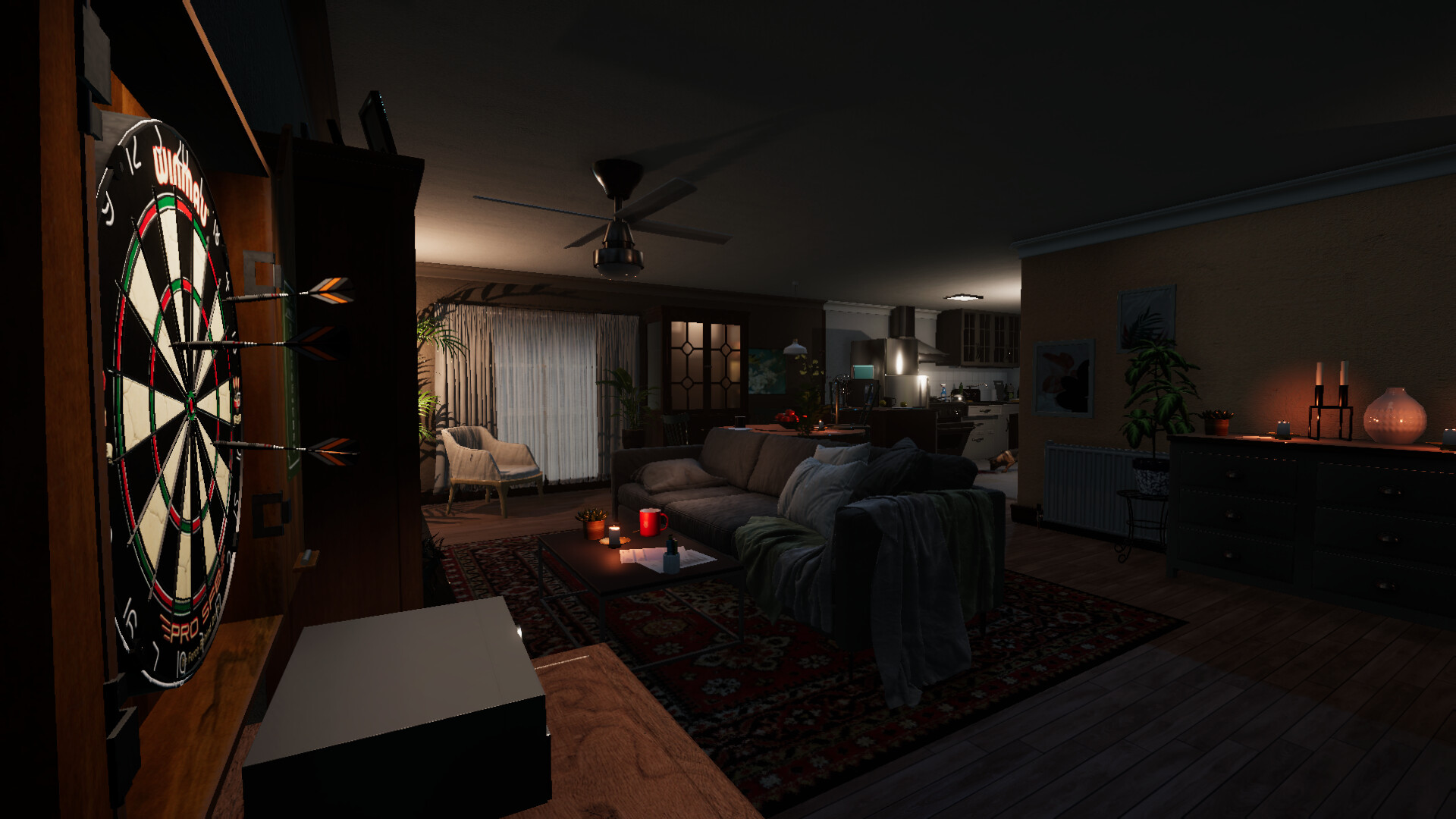
Cleaning isn’t enough either. Part of the job involves restoring the scene itself, which means furniture can be moved back into place, paintings can be rehung, and objects scattered during whatever carnage occurred need to be returned to approximately where they belong. You can pick things up, reposition them and occasionally resort to the highly sophisticated professional technique known as hitting something until it goes where you want it. We’ve all been there.
This adds another satisfying layer to each mission because you’re not merely removing dirt; you’re rebuilding the space and making it look untouched. By the time you’ve finished, some rooms can look almost completely normal again, which I suppose is exactly what the people paying you want. After all, nothing says professional criminal organisation quite like making sure the cushions are straight after removing six bodies from the building.
There is something strangely enjoyable about seeing a room slowly return to how it should look. It taps into that same satisfying feeling you get from renovation and cleaning games, except here the reason behind it is far more sinister. One moment you’re organising furniture, the next you’re wondering whether a detective is going to notice that vase is three inches further to the left than it was before the shooting.
progession that actually feels worthwhile
Managing everything is surprisingly straightforward. The tool wheel gives you quick access to equipment without forcing you through endless menus, while the Codex keeps track of mission information, objectives, character improvements and other useful details. Controller support also makes everything easy to manage without needing to rely entirely on mouse and keyboard, which is always welcome in a game where you’re constantly switching between equipment.
Considering how many different actions you’re performing throughout a mission, the controls rarely feel unnecessarily complicated. You’re cleaning, carrying, throwing things away, rearranging furniture, disposing of evidence and committing enough crimes to keep an entire law firm employed, yet it all feels fairly intuitive once you’ve spent a little time with the systems. The game avoids overcomplicating something that works best when the focus remains on the actual clean-up rather than wrestling with the controls.
The tool selection also grows naturally as you play, giving you more options without overwhelming you straight away. It means you’re gradually becoming more efficient at the job, which is probably the nicest possible way of saying that Kovalsky is becoming frighteningly good at making crime scenes disappear.
Completing jobs earns experience, which feeds into Crime Scene Cleaner’s progression system. As you level up, you can improve your abilities and make different parts of the job more efficient. Better cleaning performance means less time repeatedly attacking the same bloodstain because it personally insulted your family, while other improvements can make various aspects of the job quicker or easier to manage.
The progression works because you genuinely feel the difference as you become better equipped. Early missions teach you the basics without throwing everything at you immediately, while later environments become larger and slightly more complicated, introducing additional rooms, hidden evidence and more elaborate clean-up operations. The game gives you enough time to understand each mechanic before asking you to deal with more substantial scenes.
It never felt brutally difficult during my time with it. Instead, the challenge comes from being observant and thorough. You’re encouraged to explore rather than rush, and there isn’t some lunatic chasing you around every building while you’re desperately trying to mop a kitchen. You can actually work at your own pace, which is probably why something involving this much blood somehow becomes relaxing.

chambers of secrets, shhhh
Exploration is also rewarded throughout each location. Different missions contain hidden items, secrets and bits of evidence tucked away for curious players to discover, giving you another reason to look behind doors, investigate suspicious areas and properly explore each map rather than simply cleaning the obvious mess and heading home.
This works nicely with the level completion system because finishing the main story doesn’t mean you’re completely done. You can return to previous missions to search for things you missed, improve your completion percentage or simply replay an area with upgraded equipment. For completionists, there’s plenty here to hunt down, and some of the hidden discoveries encourage you to take a much closer look at environments you may have rushed through the first time.
Because later upgrades can make previous jobs quicker, returning to older missions doesn’t necessarily feel like repeating exactly the same process either. You walk back through the door older, wiser and armed with significantly better cleaning supplies. Basically, John Wick if his weapon of choice was a mop and his biggest enemy was a stubborn stain.
One of the more surprising parts of Crime Scene Cleaner is how chilled out it can be. There might be enough blood covering the floor to concern even Dexter Morgan, but mechanically the game rarely pressures you. You have objectives to complete, but you’re generally allowed to tackle everything at your own pace without constantly being punished for taking too long.
Cleaner Sense also prevents smaller missed details from becoming irritating, which creates a nice balance between making you pay attention and respecting your time. You’re still expected to do the job properly, but Crime Scene Cleaner understands that endlessly searching a massive room for one tiny stain isn’t difficult; it’s just annoying.
The result is one of those games where you can suddenly lose a ridiculous amount of time. You start thinking, “I’ll just clean this room,” then another room needs doing, then you find a secret, then you notice some rubbish, then there’s another body, and suddenly three hours have disappeared. Somehow, you’ve become emotionally invested in the cleanliness of a fictional murder scene, which is definitely not how I expected my evening to go.
can you see it?
Visually, Crime Scene Cleaner sits somewhere between realism and a slightly stylised appearance, and that combination works extremely well. The environments have enough detail to make the aftermath of each crime convincing without chasing photorealism to the point where everything becomes unnecessarily unpleasant to look at. Considering how much gore can be involved, that is probably for the best.
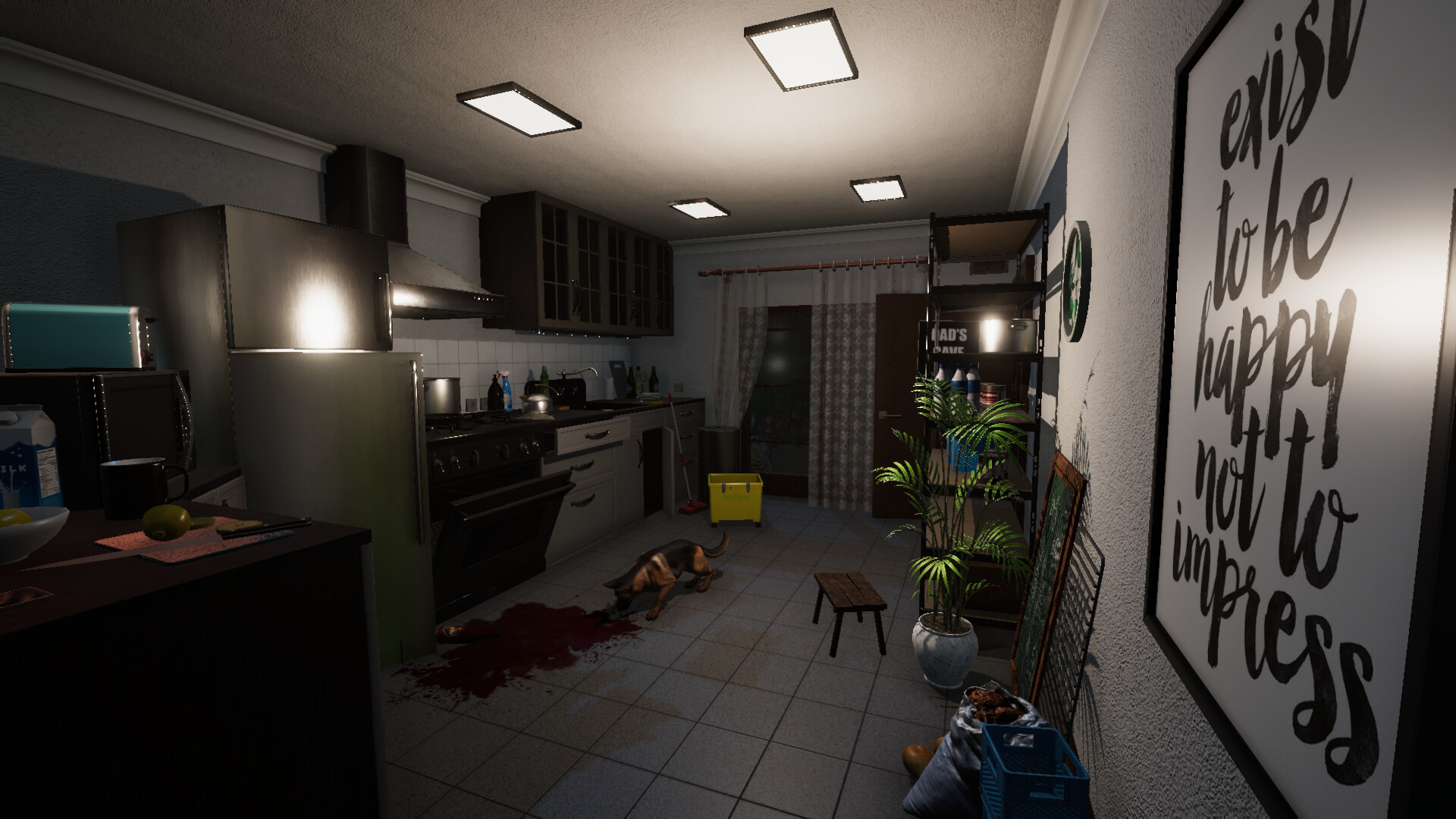
Blood splatter, damaged furniture, rubbish, environmental objects and the general destruction surrounding each crime give the locations plenty of character. The difference between arriving at a scene and leaving it completely transformed is also one of the game’s strongest visual elements. There is genuine satisfaction in looking at an area you’ve completely restored and realising that, if nobody knew better, they’d never realise anything happened there. Exactly what the boss ordered.
During my playthrough, performance also remained smooth. I didn’t experience noticeable frame-rate drops or anything substantial enough to pull me out of the experience. That matters in a simulator where you’re spending a lot of time slowly inspecting environments, moving smaller objects and searching for details that could easily be missed if the game wasn’t running consistently.
The cutscenes take a slightly different approach to traditional story presentation. Rather than constantly showing detailed character models acting everything out directly in front of you, much of the narrative is delivered through voice acting, phone calls and glimpses of the events surrounding each job. It works surprisingly well and helps maintain a little mystery around the people you’re working for.
You’re given enough information to understand what has happened without necessarily seeing every single moment. That almost makes you feel like the bloke who’s deliberately kept out of the meeting. You don’t need to know what happened, you don’t need to know why it happened, and you probably don’t want to know who ordered it. You just need to clean it.
That style of storytelling fits the criminal underworld theme nicely because Kovalsky always feels slightly removed from the people actually causing the trouble. He arrives afterwards, deals with the consequences and leaves before anyone important starts asking questions. Probably safer that way, to be fair.
did you hear that?
Audio plays a bigger role than I expected. Cleaning tools have appropriately wet and grimy sounds, objects react convincingly when they’re moved around, and the general environmental audio helps each location feel distinct. Every scrape, splash and squelch adds to the physical feeling of cleaning up the mess, even if some of those sounds are considerably more disgusting than others.
Sometimes you’ll hear the world continuing outside while you’re inside dealing with absolute carnage, which creates some brilliantly strange moments. There’s something quite funny about hearing normal city life carrying on while you’re dragging a body across someone’s kitchen. Nothing to see here, neighbours. Carry on.
The ambient sound also changes depending on the location, helping quieter scenes feel eerie while busier environments feel connected to the wider world. It gives each level its own atmosphere without constantly relying on music to do all the work.
The voice work is particularly important because so much of the narrative comes through conversations and recordings. Kovalsky’s commentary gives him personality beyond simply being the hands you’re controlling, while phone calls and voicemail messages provide extra context surrounding different jobs and the people involved.
Then there’s the mob boss. I mentioned this when I originally played the game, but I still couldn’t shake the fact that his voice reminded me of Arnold Schwarzenegger. Half the time I was expecting him to shout, “Get to the moppa!” Thankfully, that never happened because I probably would’ve dropped the bucket laughing.
Regardless of that completely unintended comparison, the performances help sell the darker side of the story and stop each mission from simply feeling like another checklist. The dialogue gives the world personality and reinforces the feeling that Kovalsky is involved with people who are considerably more dangerous than he is.
FINAL THOUGHTS
The obvious comparison is House Flipper. Both games scratch that same part of your brain where turning complete chaos into something clean and organised becomes ridiculously satisfying. The main difference is that in House Flipper you’re cleaning because somebody wants their property renovated. Here you’re cleaning because Giuseppe from down the road apparently owed somebody fifty grand. Slightly different clientele.
Mechanically, that familiarity works in Crime Scene Cleaner’s favour. If you’ve played cleaning or renovation simulators before, you’ll understand the basic rhythm almost immediately. What makes this game stand out is the context surrounding those familiar mechanics. You’re not cleaning dirt; you’re destroying evidence. You’re not removing rubbish; you’re making incriminating objects disappear. You’re not moving furniture because the sofa looks better against another wall; you’re putting it back because detectives asking why a dining table is upside down next to three bullet holes might become inconvenient.
That darker theme gives an otherwise familiar simulation formula its own identity. It takes mechanics that could easily feel predictable and completely changes the atmosphere surrounding them, making every ordinary cleaning task feel slightly more sinister.
I went into Crime Scene Cleaner expecting another simulator with an amusing gimmick, but I came out of it wondering why cleaning up after fictional mob murders is one of the most relaxing things I’ve played. President Studio has taken a concept that could easily have relied entirely on shock value and actually built a satisfying simulation game around it.
Cleaning blood, removing evidence, disposing of bodies and restoring locations creates an addictive gameplay loop, while Kovalsky’s story gives you a genuine reason to care about why you’re doing all of it. The different environments stop things from becoming too repetitive, progression gives you meaningful improvements, and Cleaner Sense saves you from spending the rest of your natural life searching behind furniture for one microscopic bloodstain.
Some areas could be expanded, especially accessibility, and naturally anyone who already dislikes cleaning simulators probably isn’t going to suddenly fall in love because someone has thrown a few corpses into the equation. But if you enjoy methodical simulation games, darker stories, crime dramas or anything with that CSI-meets-Dexter atmosphere, there’s something strangely compelling here.
What I appreciate most is that Crime Scene Cleaner lets you experience the other side of a crime scene. Usually, games ask us to find the evidence. Here, I’m the reason you can’t find any. That’s what gives the game its personality. You’re the bloke nobody talks about, the person who arrives after everything has gone wrong. You don’t pull the trigger; you don’t ask why the trigger was pulled; you grab your mop, load the bodies into the van and make the entire thing somebody else’s unsolved case.
So, if the phone rings tonight and a mysterious voice tells you they’ve got a little cleaning job that needs taking care of, do yourself a favour. Don’t ask how much blood there is. Just bring an extra bucket, because in this business there’s always another mess to clean.
And remember…
You didn’t see anything.
Neither did I.
A key for Crime Scene Cleaner was provided for review purposes.
Positives
✅ Strangely satisfying gameplay loop – Cleaning blood, collecting evidence, bagging rubbish and disposing of bodies sounds grim, but it becomes surprisingly relaxing once you get into the rhythm.
✅ Great crime-scene atmosphere – Each location feels like it has its own story, with destroyed rooms, hidden areas and environmental details that make you wonder what happened before you arrived.
✅ Cleaner Sense is genuinely useful – It stops you spending forever searching for one microscopic bloodstain hiding behind a chair.
✅ Strong progression system – Upgrades and new tools make you noticeably more efficient, so you actually feel like you’re becoming better at the job.
✅ Good level variety – Different environments help stop the cleaning from becoming repetitive, while secrets and hidden items give you a reason to properly explore.
✅ Dark humour works really well – The serious criminal setting mixed with the absurdity of carefully tidying furniture after removing several bodies gives the game a great personality.
✅ Solid voice acting and storytelling – Kovalsky’s situation gives the game more emotional weight than you might expect from a cleaning simulator.
✅ Replay value – You can return to previous jobs to find missed secrets, improve your completion percentage and tackle them again with upgraded equipment.
Negatives
❌ The core gameplay can become repetitive – No matter how entertaining the theme is, you are still cleaning, carrying bodies and collecting evidence for long stretches.
❌ Finding the last few stains can still be frustrating – Cleaner Sense helps massively, but chasing that final percentage can occasionally become a bit tedious.
❌ Object placement can sometimes feel fiddly – Putting furniture and smaller items back exactly where they belong isn’t always as smooth as the actual cleaning.
❌ Not everyone will enjoy the slower pace – If you prefer constant action, the methodical nature of cleaning every corner of a crime scene may not hold your attention.

Co-owner of Indie Critical. I’m passionate about highlighting independent voices in film, games, and culture. I focus on honest, thoughtful reviews and love helping great indie projects get the recognition they deserve. When I’m not writing or editing, I’m probably diving into the latest hidden gem or discovering the next big thing in the indie scene.
Written by

Lewis Langton