Why do we dream? Is it simply our brain processing memories and emotions, or is there something far more complicated happening while we’re asleep? Dreams can be strange, confusing and sometimes downright ridiculous, yet we rarely stop to question what they actually mean. Are they nothing more than our imagination running wild, or could our subconscious be trying to tell us something?
For example, iRobot, a 2004 science-fiction film, we’re introduced to Sonny, an artificial intelligence capable of something rather extraordinary: dreaming. It’s a fascinating concept that raises questions about consciousness, emotions and whether dreams are more than just images created by our minds. After all, if a machine can experience them, what does that tell us about the human imagination? Perhaps the strangest part of dreaming isn’t what we see, but why our minds choose to show it to us in the first place.
This brings me to A Dream About Parking Lots, an unusual indie experience developed by Interactive Dreams, that explores the meaning behind recurring dreams and the unsettling feeling of being lost. Rather than throwing us into a terrifying world filled with monsters or supernatural creatures, the game presents something considerably more ordinary: a series of parking lots where you’re desperately trying to find your car. Yes, apparently even when we’re asleep, we can’t escape the frustration of forgetting where we’ve parked.
i had a dream
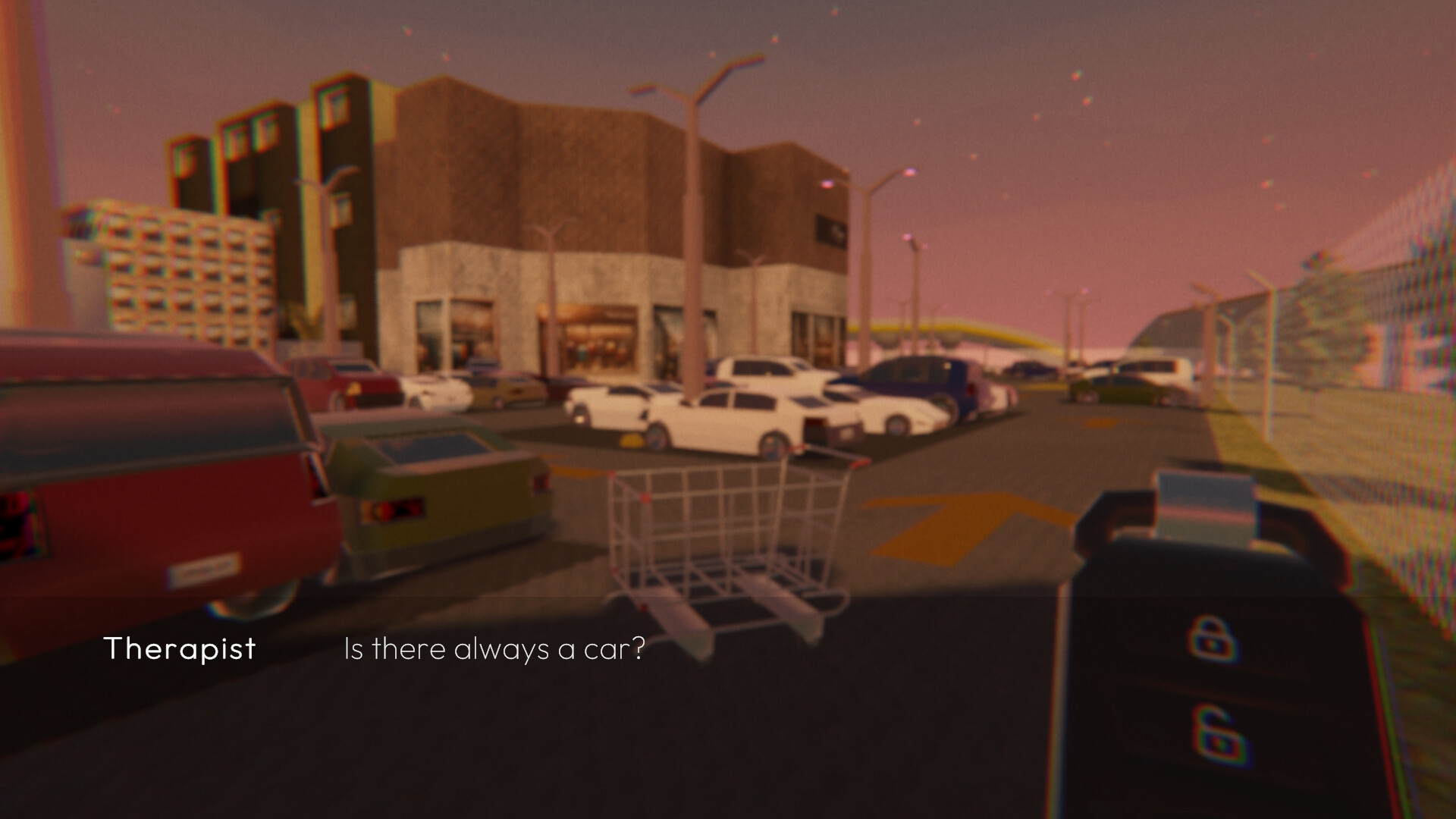
A Dream About Parking Lots puts you in the shoes of a patient known simply as the “Dreamer”, who is attending therapy to better understand a rather unusual recurring dream. During these sessions, he discusses his experiences with a therapist, particularly his constant struggle to find his missing car in seemingly endless car parks. It might sound like a rather ordinary inconvenience, but there’s clearly more going on beneath the surface than simply forgetting where you’ve parked.
Each therapy session takes you into a new dream, where your objective is to… yep, you guessed it, find your car. Again. You’d think by now the poor bloke would have learnt to take a picture of where he parked, but apparently that’s asking a bit too much. However, as you progress through these dreams, it becomes apparent that there’s more to this repetitive experience than meets the eye, with each conversation offering a little more insight into the Dreamer’s thoughts and emotions.
why parking lots?
When it comes to gameplay, A Dream About Parking Lots takes a rather straightforward approach, presenting itself as a first-person walking simulator where your main objective is to locate your missing car. Thankfully, you’re not expected to wander around aimlessly without any assistance, as you’re equipped with a car key that acts as a handy little navigation tool. By pressing it, you’ll hear the familiar beep of a car being unlocked, accompanied by flashing lights whenever you’re close enough. The nearer you get, the easier it becomes to pinpoint its location. However, finding your vehicle doesn’t necessarily mean you can jump straight inside and drive off into the sunset.
You’ll first need to finish listening to your therapist, which occasionally leaves you standing beside your car, patiently waiting for the conversation to end. Throughout your journey, you’ll participate in several therapy sessions, each introducing a different environment to explore and new conversations about the Dreamer’s experiences.
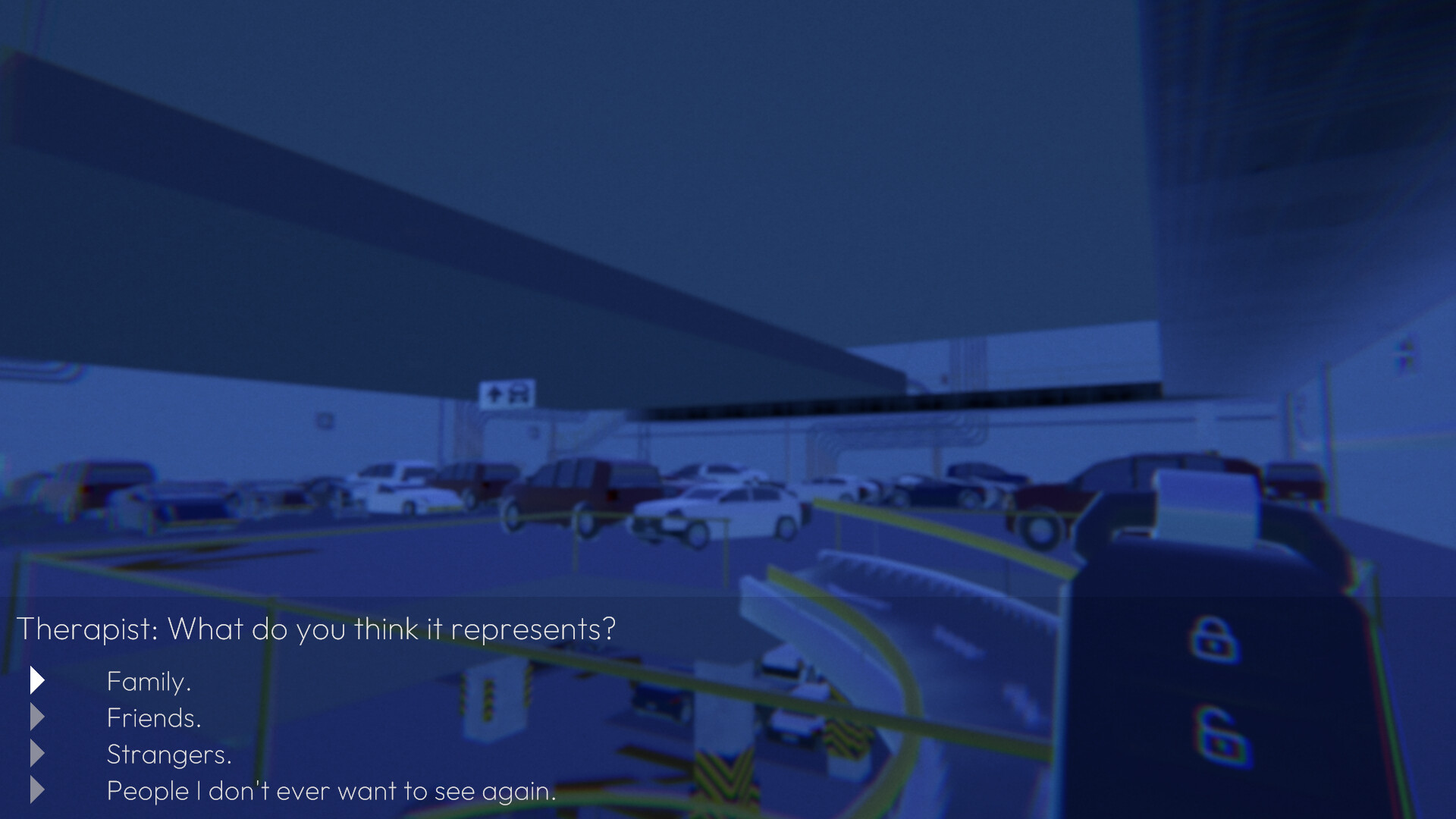
During these discussions, you’re presented with three dialogue options, allowing you to choose how you respond to your therapist’s questions. It’s a nice little addition that gives you some involvement in the conversations rather than simply listening to someone talk throughout the entire experience. However, I did find the numbering of the dream sequences rather confusing. For example, you could find yourself exploring Dream 1, only for the next sequence to be labelled Dream 5, followed by something like Dream 22. Whether this was an intentional creative decision or simply part of the game’s unusual presentation, it left me scratching my head more than once.
Movement is another area where I felt the experience could have benefited from a little more attention. You can walk or sprint around the environments, although sprinting only increases your movement speed by approximately 5%, making the difference barely noticeable.
Considering how much time you’ll spend searching for your vehicle, having a more substantial sprinting option would have been greatly appreciated. Some environments also feel unnecessarily stretched out, particularly when you’re navigating what essentially resembles a maze, only to discover that your car is conveniently sitting right at the very end. Rather than making the search feel rewarding, these sections occasionally gave me the impression that the developers were deliberately extending the experience.
Despite these frustrations, A Dream About Parking Lots is a relatively short game, taking roughly 40 minutes to complete, depending on how quickly you navigate each environment.
For trophy hunters, it’s also an incredibly easy Platinum to add to your collection, so there’s certainly something to celebrate if you enjoy watching those trophies pop. However, while I appreciate the unusual concept and the attempt to explore dreams through interactive therapy sessions, I couldn’t help feeling that the gameplay needed a little more variety. There’s only so many times you can lose your car before you start wondering whether the Dreamer should consider taking the bus instead.
therapy session in progress
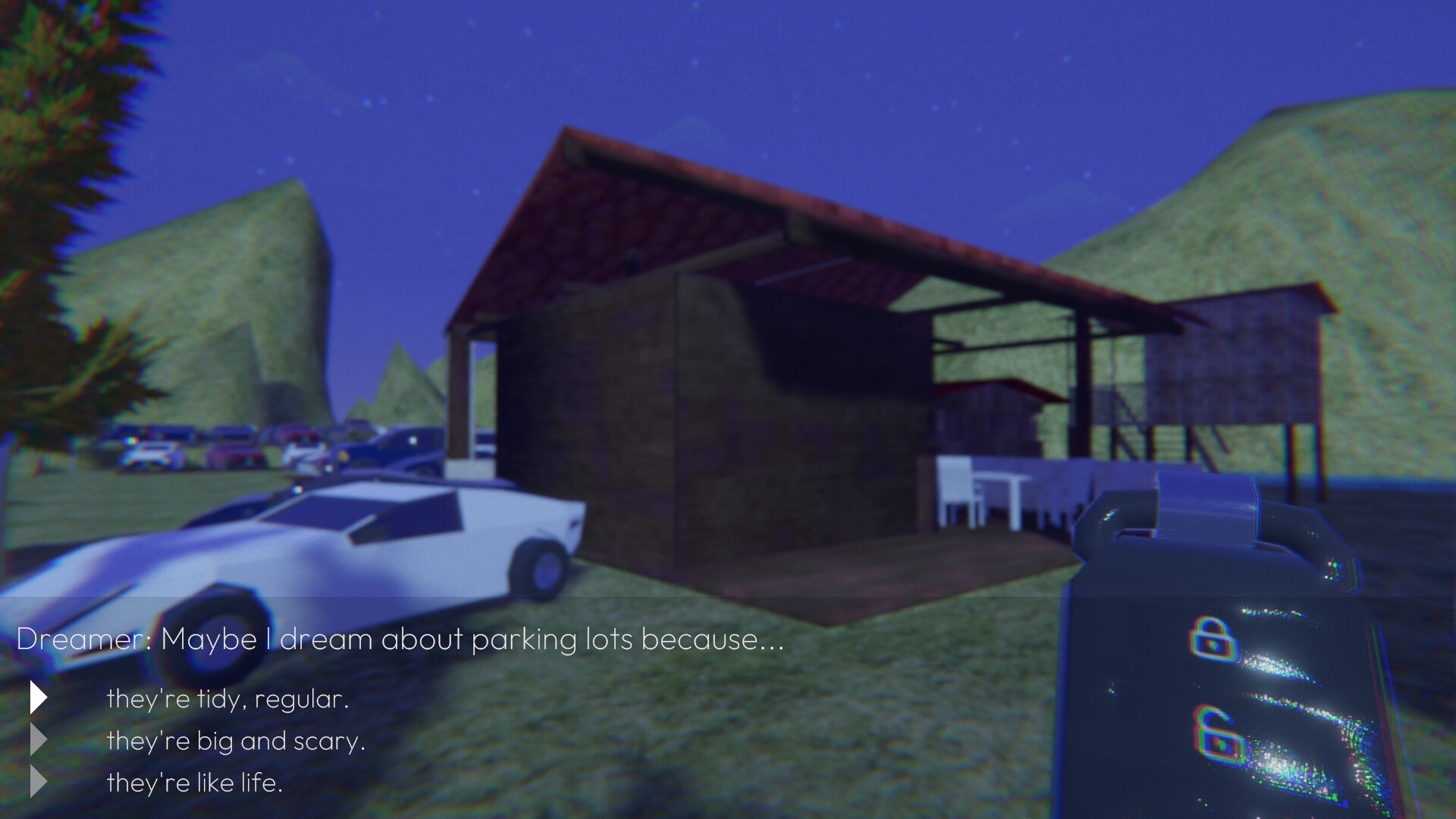
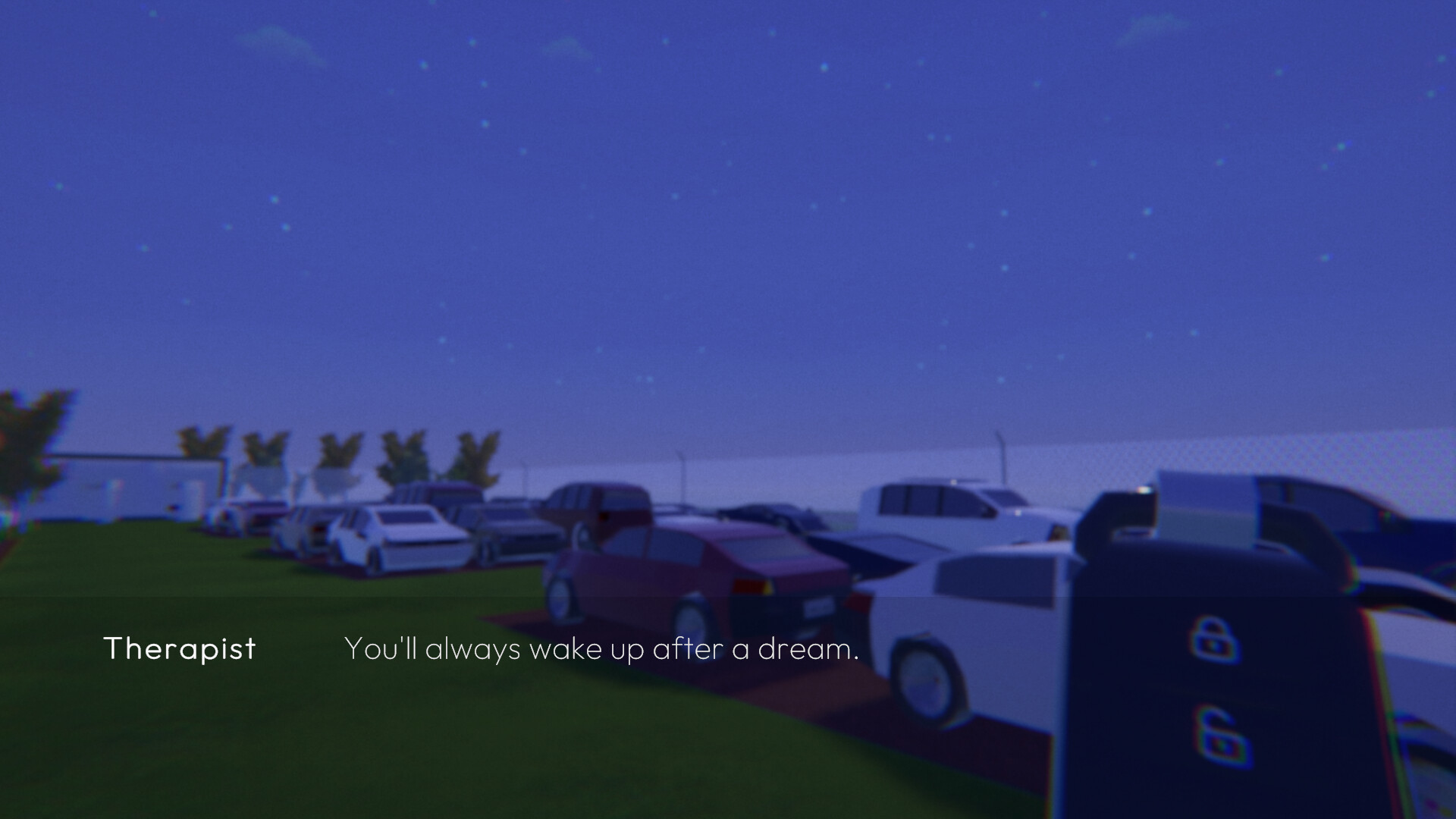
When it comes to visuals, A Dream About Parking Lots reminds me of a strange mixture between The Backrooms and those unsettling liminal spaces you occasionally stumble across online, except there aren’t any horrifying creatures waiting to chase you around. Instead, you’re left exploring enormous, almost deserted locations that feel familiar but slightly out of place. The graphics have an old-school PlayStation appearance, with low-poly models, basic textures and a slightly blurry presentation. Personally, I quite like this approach, as it suits the game’s unusual concept without trying to be something it isn’t. However, while the retro aesthetic has its charm, there are moments when the environments look a little too basic, particularly when you’re staring at large stretches of empty space with very little detail to catch your attention.
One thing I appreciated was how each level offered something different visually. Although you’re constantly searching for your missing vehicle, the developers have tried to change the surroundings rather than simply recycling the same parking lot. One level, for example, transforms an entire football pitch into a car park, which is certainly an interesting design choice. I’m not entirely sure who approved that planning permission, but I wouldn’t fancy explaining it to the local council. The vehicles also come in different shapes, sizes and colours, helping to break up the scenery and making the parking areas feel a little more believable. That being said, the cars themselves aren’t particularly detailed, and while their variety is welcome, they don’t always do enough to make the larger environments visually interesting.
The sheer size of some levels is another aspect worth discussing. On one hand, having these enormous spaces helps capture the feeling of being lost in a dream, especially when everything around you looks strangely familiar. There’s something uncomfortable about wandering through an almost deserted car park with no clear indication of where you’re supposed to go. On the other hand, I sometimes felt the developers had gone a little overboard with the scale. Certain areas are so large and lacking in detail that exploring them becomes more tedious than interesting. I understand that feeling lost is part of the experience, but there’s a difference between creating an unsettling atmosphere and making me feel like I’ve been walking around the same car park for half my life.
I also want to give some attention to the skyboxes, as I found them to be one of the more appealing parts of the game’s visual presentation. The different skies help establish the mood of each dream, with their colours and distant horizons adding a sense of atmosphere to otherwise fairly simple surroundings. At times, I found myself stopping to look around and appreciate the scenery, particularly when the sky contrasted nicely with the strange environment beneath it. However, I wouldn’t say they’re anything groundbreaking from a technical perspective, and some backgrounds feel rather plain. Still, they provide a welcome change from the endless concrete and parked vehicles, giving these unusual dream sequences a little more personality.
There are some genuinely interesting ideas behind the visual design, particularly the way familiar places are transformed into locations that wouldn’t make much sense in the real world. I enjoyed seeing what each new dream had to offer, and the liminal atmosphere certainly gives the game an identity of its own. Unfortunately, the lack of environmental detail and the occasionally excessive level sizes mean the presentation doesn’t always remain as engaging as it could. The retro style works in its favour, but I do think a little more variety within the individual locations would have made wandering through them considerably more enjoyable.
the music is the best part
If there’s one thing I genuinely enjoyed about A Dream About Parking Lots, it’s the music, particularly the beautiful opening theme, Erik Satie’s Gymnopédie No. 1. In fact, I’d go as far as saying it’s my favourite part of the entire game. There’s something incredibly relaxing about listening to the gentle piano melody while wandering through these strange environments. The classical soundtrack creates a peaceful atmosphere that contrasts nicely with the unsettling nature of the dreams. Each level features another piece from Satie’s collection of compositions, which I thought was a lovely touch. However, I do wish the opening theme had been used more frequently throughout the experience, as none of the other pieces quite captured my attention in the same way.
Unfortunately, while the music deserves some praise, the actual sound design is where things become a little frustrating. Audio plays an important role in the gameplay, particularly when you’re trying to locate your missing car. By pressing your car key, you’ll hear a familiar unlocking beep, which is supposed to help you determine where your vehicle is parked. Sounds simple enough, right? Well, not quite. During my playthrough, I noticed that the directional audio didn’t always seem to match the location of the car. For example, I could hear the beeping coming through my left headphone, suggesting the vehicle was somewhere to my left, only to discover that it was actually on my right. As you can imagine, this became incredibly annoying, especially when the entire objective revolves around following that sound. I spent more time questioning my hearing than actually finding the blooming car!
Outside of the music and car alarm, there’s a decent selection of ambient sounds that help bring the otherwise empty environments to life. You’ll hear the wind blowing, crickets chirping, birds singing and your own footsteps as you wander around the different locations. These little details might not sound particularly exciting, but they help prevent the larger areas from feeling completely silent. I especially liked how the natural background noises worked alongside the softer classical pieces, creating a calm atmosphere that almost made me forget I was supposed to be searching for a vehicle. Although, given how confusing some of these car parks were, perhaps stopping to appreciate the birds was the better option.
It’s also worth mentioning that A Dream About Parking Lots doesn’t feature any voice acting. Instead, conversations between the Dreamer and his therapist are presented entirely through text, with players selecting their responses from the available dialogue options. Personally, I don’t think the absence of spoken dialogue is necessarily a bad thing, especially for such a short experience. However, I do feel that hearing the therapist’s voice could have added a little more personality to the sessions and made the conversations feel more personal. Considering how much of the game revolves around discussing your dreams, having some actual voice work might have helped me feel more connected to what was being said.
FINAL THOUGHTS
A Dream About Parking Lots is certainly one of the more unusual games I’ve played recently, and I genuinely appreciate what Interactive Dreams was trying to achieve. Taking something as ordinary as losing your car and turning it into an experience about recurring dreams, therapy and the human subconscious is an interesting concept. I particularly enjoyed the conversations with the therapist, as they gave me something to think about beyond simply wandering around looking for my vehicle. However, while the idea behind the game caught my attention, I can’t say the execution always managed to keep me interested.
The visuals have their own charm, especially if you’re someone who enjoys liminal spaces and that strange Backrooms-style atmosphere. I also absolutely loved the classical soundtrack, with Erik Satie’s Gymnopédie No. 1 being the highlight of the entire experience for me. Unfortunately, the gameplay becomes repetitive rather quickly, and the unnecessarily large environments don’t exactly help matters. Throw in the frustrating directional audio, a sprint button that barely makes a difference and the occasional confusion surrounding the dream sequences, and you’ve got an experience that sometimes feels more like a chore than an enjoyable adventure. At one point, I was beginning to think the therapist should be helping me deal with the frustration of finding the blooming car rather than interpreting my dreams.
One thing I will give the game credit for, though, is its ending, which I found genuinely interesting. Without giving anything away, it left me thinking more about the Dreamer’s experiences and what the recurring dreams might actually represent. It’s one of those moments that encourages you to reflect on everything you’ve been doing throughout the game, rather than simply accepting it as another strange dream. I appreciated that the developers tried to give the experience some meaning beyond searching for a missing vehicle, although I do wish the journey leading up to that conclusion had been a little more engaging.
With a playtime of roughly 40 minutes and an easy Platinum trophy up for grabs, A Dream About Parking Lots doesn’t demand much of your time, which is probably one of its biggest advantages. There’s a genuinely creative idea hiding beneath its simple presentation, and I can see it appealing to players who enjoy short, experimental games that explore unusual subjects. Personally, though, I walked away with mixed feelings. I enjoyed the concept, the relaxing music and the thought-provoking ending, but the repetitive gameplay and frustrating mechanics prevented me from enjoying the experience as much as I’d hoped.
Would I recommend it? If you’re fascinated by dreams, enjoy atmospheric walking simulators or simply fancy adding another easy Platinum to your collection, there’s enough here to justify giving it a go. Just don’t expect anything particularly groundbreaking. As for me, I think I’ve spent enough time searching for a missing car to last a lifetime. Next time I have a dream like this, I’m taking the bus.
A code for A Dream About Parking Lots was provided for review purposes.
Positives
✅ Beautiful Classical Soundtrack – Erik Satie’s Gymnopédie No. 1 is a standout, creating a wonderfully relaxing atmosphere.
✅ Interesting Concept – Exploring recurring dreams through therapy sessions offers a unique approach to storytelling.
✅ Thought-Provoking Ending – An interesting conclusion that gives you something to think about without spoiling the experience.
✅ Unique Dream Environments – Each level features a different setting, with a retro aesthetic and unsettling liminal atmosphere.
✅ Easy Platinum Trophy – A straightforward Platinum for trophy hunters, with roughly 40 minutes of gameplay.
Negatives
❌ Repetitive Gameplay – Searching for your missing car in every level becomes predictable rather quickly.
❌ Frustrating Directional Audio – The car alarm’s sound direction can be misleading, making it unnecessarily difficult to locate your vehicle.
❌ Unnecessarily Large Levels – Some environments feel stretched out, with maze-like layouts that add little to the experience.
❌ Barely Noticeable Sprinting – A sprint speed increase of approximately 5% makes getting around the larger areas frustrating.
❌ Repetitive Gameplay – A lack of mission variety and inconsistent enemy behaviour make progression increasingly predictable.
❌ Limited Visual Detail – Despite the interesting environments, some locations feel overly empty and lack variety within individual levels.

Owner of Indie Critical. I’m passionate about highlighting independent voices in film, games, and culture. I focus on honest, thoughtful reviews and love helping great indie projects get the recognition they deserve. When I’m not writing or editing, I’m probably diving into the latest hidden gem or discovering the next big thing in the indie scene.
Written by

Lewis Langton